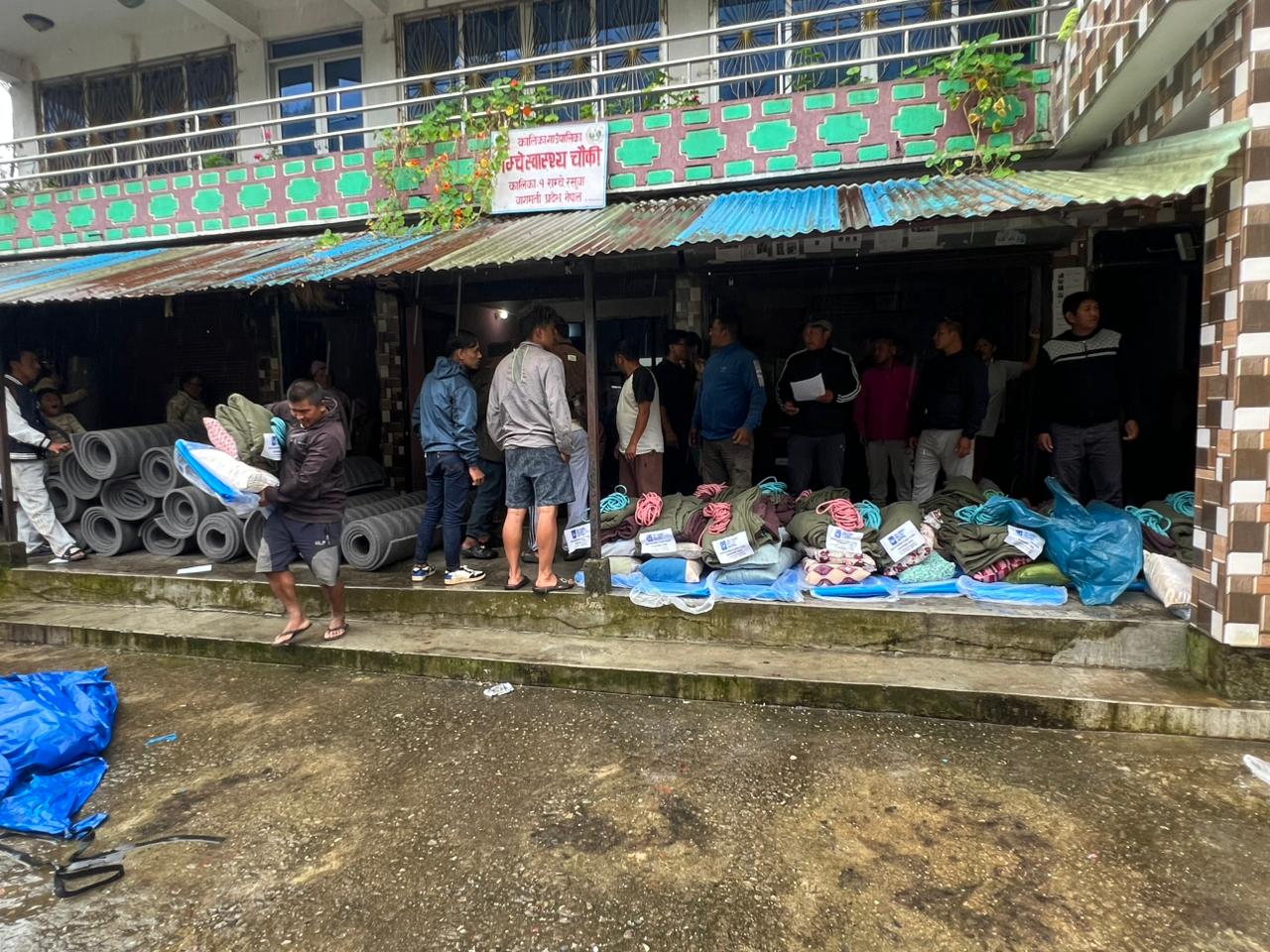
Survivors of the Nepal floods still urgently need shelter, with Islamic Relief aid workers on the ground reporting thousands of families still displaced and homes submerged in mud and silt.
The death toll continues to rise and has now passed 1,300 with around 5,000 people still missing. Islamic Relief is working with local authorities to distribute an initial 1,000 emergency shelter kits to families who have lost their homes, but much more is needed.
The ongoing heavy rain and the destruction of dozens of roads and bridges mean that getting aid to people is an enormous task. Large trucks are unable to pass the blocked roads, so smaller trucks have to be used and journeys that should take 4-5 hours now take 13-15 hours.
Islamic Relief aid worker Pragya Adhikari travelled to flood affected areas of Galchi, Dhading She said:
“The suffering I can hear and see is so tragic. Even three storey buildings are inundated with sand and debris, with the floods reaching 8 or 9 metres high. Many children have been orphaned as they were at school while the floods killed their parents. Other entire families are still missing – I heard of families of 24 and 30 people who are still unaccounted for.
“The level of flooding and trauma of people that have lost their family is something these communities have never seen before. I met an elderly man in his seventies who told me he’d never seen flooding like this in his lifetime. He said it’s at least four times bigger than even the most intense flood they can remember.
“Recovery will take a lot a lot of time. Some areas are still only accessible by helicopter, but we have to start debris clearance as quickly as possible.”
Iccharam Thapa Magar, an Islamic Relief aid worker managing the response in Rasuwa, said:
“All the connecting roads from Kathmandu to Rasuwa were devastated and destroyed. It took around 15 hours to reach here, mostly off road crossing the jungle and many narrow mountainous dirt roads. There was heavy rainfall and the roads were treacherous on the way. But we arrived around midnight to deliver aid the next day.
“Most displaced people we met in Grang and Ramche have lost at least one family member. They were crying and numb. When we brought them supplies, they said they wished we could bring back their loved ones instead.”
Many families who have lost their homes are staying in overcrowded community shelters, or on the floor of relatives’ homes. Islamic Relief’s emergency shelter kits contain items such as tarpaulin, blankets, pillows, and foam mattresses.
Many survivors told Islamic Relief staff how their life’s work has been swept away overnight. In Galchi, Dhading, Sharmila Pakhrin told us that she and her partner saved for 33 years to build a home that is now uninhabitable. She said they had spent years transporting and selling sand from the river to earn an income, but now the house is filled with sand left by the floods.