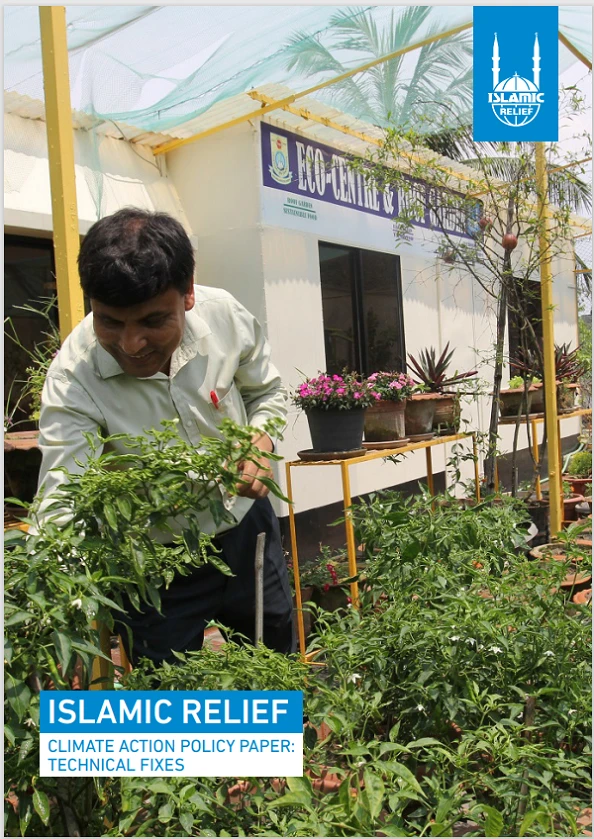
In rural Bangladesh, women carry the heaviest burden of household labour. They collect water, gather firewood and buy cooking fuel, manage their home’s sanitation and hygiene, and ensure their families’ food and nutritional needs are met. Yet when climate shocks strike, these same women often have no access to the resources they need to adapt to climate change. This structural exclusion makes them disproportionately vulnerable in times of crisis.
Vokti knows this reality well. She lives in Monirampur, Jashore – a climate-vulnerable, waterlogged area where floodwaters remain stagnant for more than 8 months every year. Living as a housewife with her husband, daughter, and parents, Vokti struggles to make ends meet. Her husband, an agricultural labourer, earns just 300 BDT (£1.84) per day. Due to frequent climate hazards, he can only work around 15 days each month, bringing home no more than 4,500 BDT (£27.55).
To cope with the shortfall, Vokti was forced to take loans from traditional interest-based microfinance institutions under harsh conditions. She accumulated 25,000 BDT (£153.07) in debt and eventually mortgaged her small piece of cultivable land, pushing her family into food insecurity. Like countless women in her community, she was trapped in a cycle of debt that stripped away her dignity.
But the cycle began to break in 2023.
Building resilience from the ground up
In December 2022, Islamic Relief launched our Scaling up Inclusive Climate Resilience of Vulnerable Communities through Locally Led Adaptation (ICRA) in Bangladesh. Working with the 1,000 most vulnerable households in Monirampur, the programme organised women into 45 Self-Help Groups (SHGs), with 20-25 women in each group based on household proximity.
Every week, women like Vokti gathered for yard meetings to discuss climate vulnerabilities and practical adaptation strategies. As chairperson of her SHG and vice-chairperson of the Apex Body – the umbrella organisation uniting all 45 groups – Vokti received training on income-generating activities, group management, financial management, and leadership.
The critical breakthrough came when the groups recognised that access to dignified, ethical finance was essential for disaster preparedness. This is where Islamic principles became transformative.
The Islamic difference: Finance rooted in justice
Islamic microfinance operates on fundamentally different principles than conventional lending. At its core lies the prohibition of riba (interest), which Islam views as exploitative and particularly harmful to the vulnerable. Instead, Islamic finance emphasises takaful (mutual solidarity), zakat (wealth redistribution), and risk-sharing rather than risk-transfer.
Each SHG initiated group, with members contributing 10-50 BDT (£0.06 to £0.30) weekly based on their capacity. From these collective savings, they created emergency funds enabling members to borrow 2,000-5,000 BDT (£12.25 – £30.71) interest-free, with flexible repayment terms during crises – embodying the Islamic principle of benevolent loans.
Following training and 18,000 BDT (£110.21) project grants per household, women invested in adaptive businesses. As enterprises grew, the groups made a collective decision rooted in mutual consultation: they would build a larger adaptation fund through reinvested business income, with members contributing 200-500 BDT (£1.22 – £3.06) weekly based on their ability to.
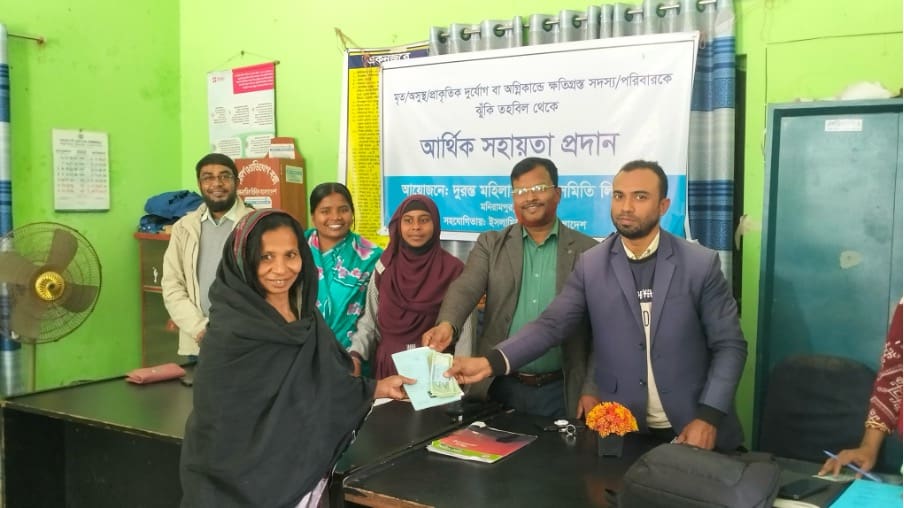
This fund became a lifeline. Vokti accessed emergency funds for urgent needs – cow feed, house repairs, and building a bamboo bridge during waterlogging. She borrowed from the adaptation fund to buy goats, hens, and ducks for income generation. Without this fund, she would have been forced back to exploitative microfinance institutions, damaging the very assets that now sustain her family.
Strengthening collective power
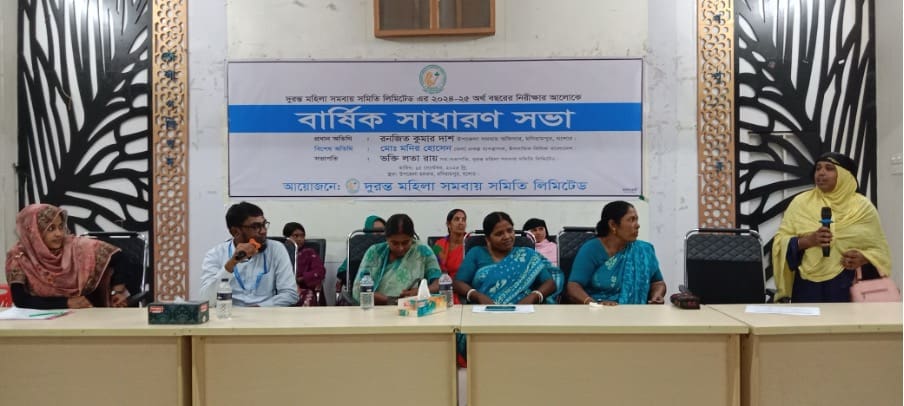
The 45 SHGs federated into an Apex Body with 12 members – 5 in the executive body and 7 general members – building links with government service providers, local authorities, and external donors. With this stronger collective voice, the women designed financing tools rooted in Islamic mutual support.
For immediate food security during lean periods, they established schemes providing essential packages on one-month credit. For larger disaster-related expenses, they created a takaful – an Islamic mutual fund where members pool resources to support families when crisis strikes. Unlike conventional insurance, which extracts profit from vulnerable communities, takaful operates on shared responsibility, with members collectively managing and distributing funds according to need.
Looking beyond immediate crises, the Apex Body is building long-term financial resilience through a Social Business Fund – mobilised through share-selling, donations, and collective savings. This represents a fundamental shift from dependence on external projects to community-owned financial infrastructure, embodying the Islamic principle of self-reliance within communal solidarity.
A transformation in practice
Reflecting on this change, Vokti says: “Once we were fully dependent on external support and relief materials during disaster. Now we are capable enough to manage ourselves using our own funds, avoiding high-interest debt. It has saved our dignity, and we are empowered now.”
Her words capture the programme’s deepest achievement: financial decision-making power in women’s hands. This model honours the Islamic principle of women’s economic empowerment – affirmed in the Qur’an through figures like Khadijah (RA), the wife of the Prophet Muhammad (peace be upon him), and a successful merchant. Women are active leaders and decision-makers shaping their own futures.
A model for adaptation
Islamic microfinance, rooted in justice, equity, and risk-sharing, is reshaping disaster preparedness in Bangladesh. By enabling women to build their own financial safety nets free from exploitation, this approach demonstrates that when communities are trusted with resources and collective decision-making, they can lead effective responses to the climate crisis.
The shift from dependence to dignity isn’t just about weathering the next flood – it’s about fundamentally transforming how vulnerable communities prepare for, respond to, and recover from climate shocks.
With your support, Islamic Relief can continue to scale these solutions, empowering families in Bangladesh and beyond to face the future with strength, resilience, and hope.
Donate today and be part of this transformation.