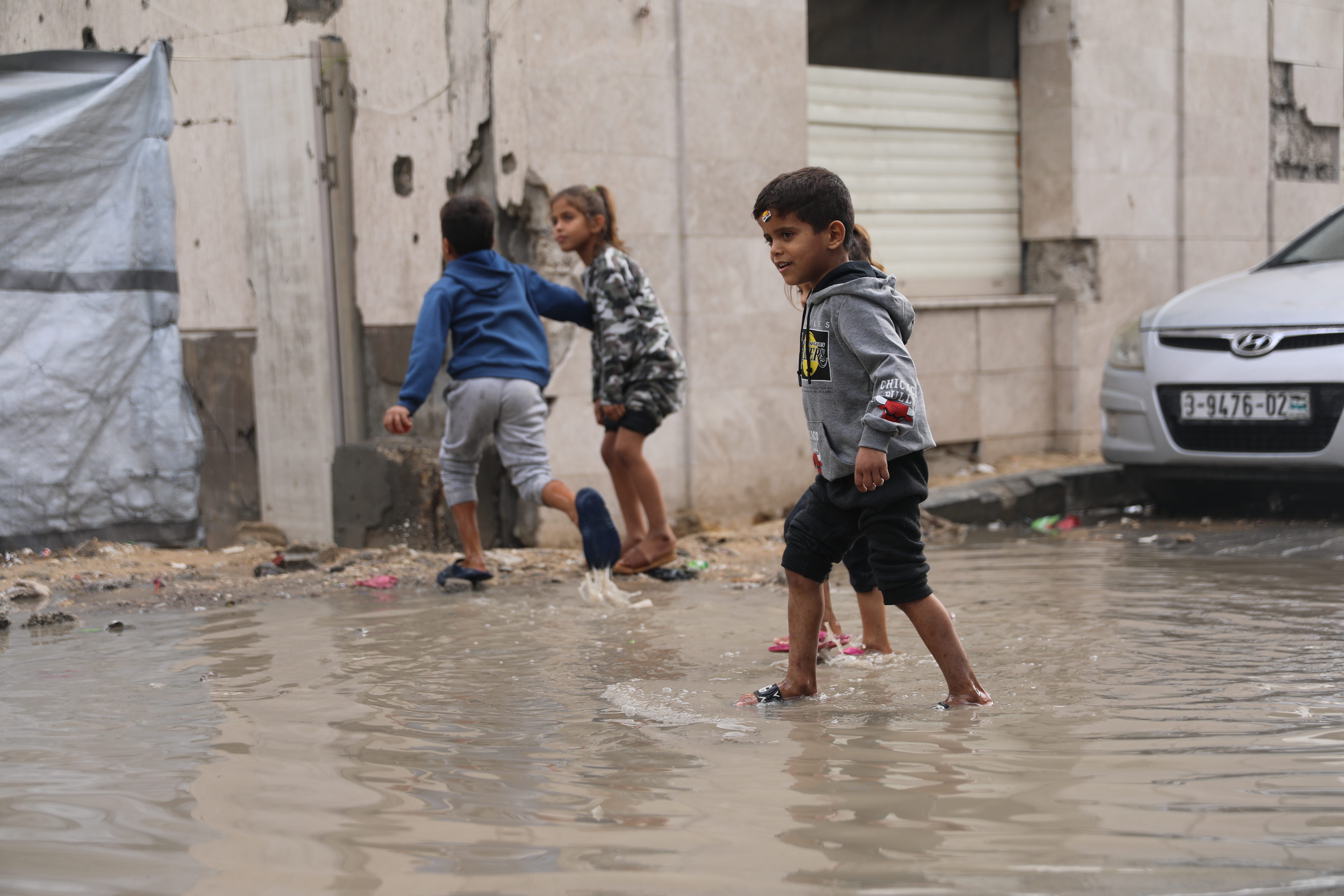
Palestinian families in Gaza face a worsening nightmare as winter sets in, Islamic Relief warns. More heavy rains today have flooded tents and shelters with water and raw sewage, but Israel continues to block much vital humanitarian aid from reaching people as Storm Byron approaches.
New analysis shows that in the two months since the ceasefire was announced, an average of just 128 trucks a day reached people in Gaza – far less than a quarter of the agreed 600 trucks a day(1). Families are flooded and starving while new tents, medicine and winter aid remains blocked from entering just a few miles away.
The crisis is expected to worsen if Storm Byron hits Gaza in the coming days, bringing record rainfall and putting hundreds of thousands of people at risk. Young children and elderly people are at particular risk of hypothermia and deadly water-borne diseases.
Most Palestinians are now penned into a tiny enclave within Gaza where conditions are overcrowded and desperate. Almost all infrastructure is damaged or destroyed, and homeless families are spending freezing nights in flimsy tents while others sleep on the rubble of their destroyed homes with nowhere else to go. After repeated forced displacement, most families have few possessions left and the floods are destroying people’s meagre blankets, tents, beds and warm clothes.
Islamic Relief is distributing food to flood-affected families and working with UNICEF to provide warm clothes, blankets and other winter aid to thousands of orphaned and vulnerable children. However, far more is desperately needed. Around 1.5 million people need urgent shelter supplies, according to the interagency Shelter Cluster.
An Islamic Relief aid worker in Gaza says:
“We’re seeing skin infections and diseases spread among children who are living in tents that are flooded by sewage, as Israeli bombing has destroyed Gaza’s sanitation system. The whole situation is catastrophic and there is a huge gap between the scale of needs and the aid that’s getting in. At distribution points we’re met by thousands of desperate people, but there isn’t enough aid for everyone who needs it.
“People are still starving and resorting to eating animal feed or boiling wild plants because there isn’t enough food. The shortage of medical supplies has turned treatable injuries into death. Pregnant women are malnourished and undergoing C-sections without anaesthetic. The lack of hygiene kits and clean water has denied people their basic dignity and women in the camps tell us they’ve had no sanitary pads or soap for months.”
The extreme weather is now making movement for displaced people and humanitarian aid even more challenging.
Humanitarian aid is a legal obligation under international law, yet despite the ceasefire agreement Israel has rejected or blocked dozens of NGO requests to bring aid into Gaza. Aid worth tens of millions of dollars remains stuck in warehouses – including tens of thousands of tents, shelter materials and winter aid, as well as medicine, nutritious food, sewage pumps and other vital supplies.
Two months into the ceasefire agreement we are seeing daily violations carried out with impunity. Israel continues regular bombing and attacks, killing more than 376 Palestinians and wounding around 1,000 since the ceasefire was announced, while also continuing to destroy homes and infrastructure. There are growing fears that the ceasefire is being used to entrench Israel’s illegal occupation and expulsion of Palestinians from their land.
International governments must hold parties accountable for violations of the ceasefire agreement. World leaders must urgently use all possible means to increase pressure on Israel to guarantee full independent humanitarian access, in accordance with international law.
Notes
(1) This analysis is based on a review of data from the UN2720 tracking mechanism: https://app.un2720.org/tracking/arrived