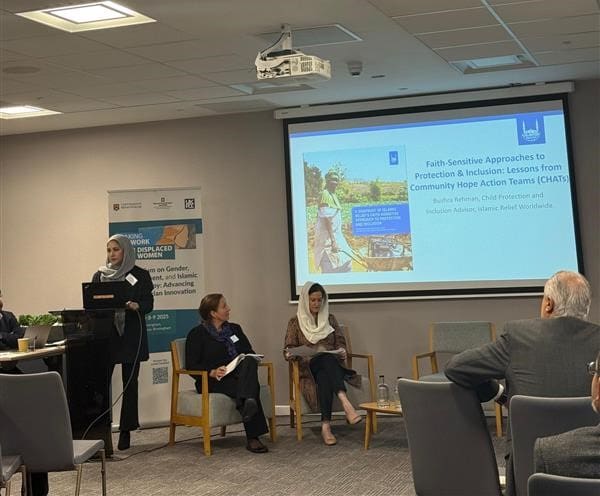
In September 2025, Islamic Relief presented a paper at the Symposium on Gender, Displacement, and Islamic Philanthropy: Advancing Humanitarian Innovation at the University of Birmingham. The event brought together practitioners, academics, and faith-based organisations from around the world to reflect on new models for inclusive humanitarian action.
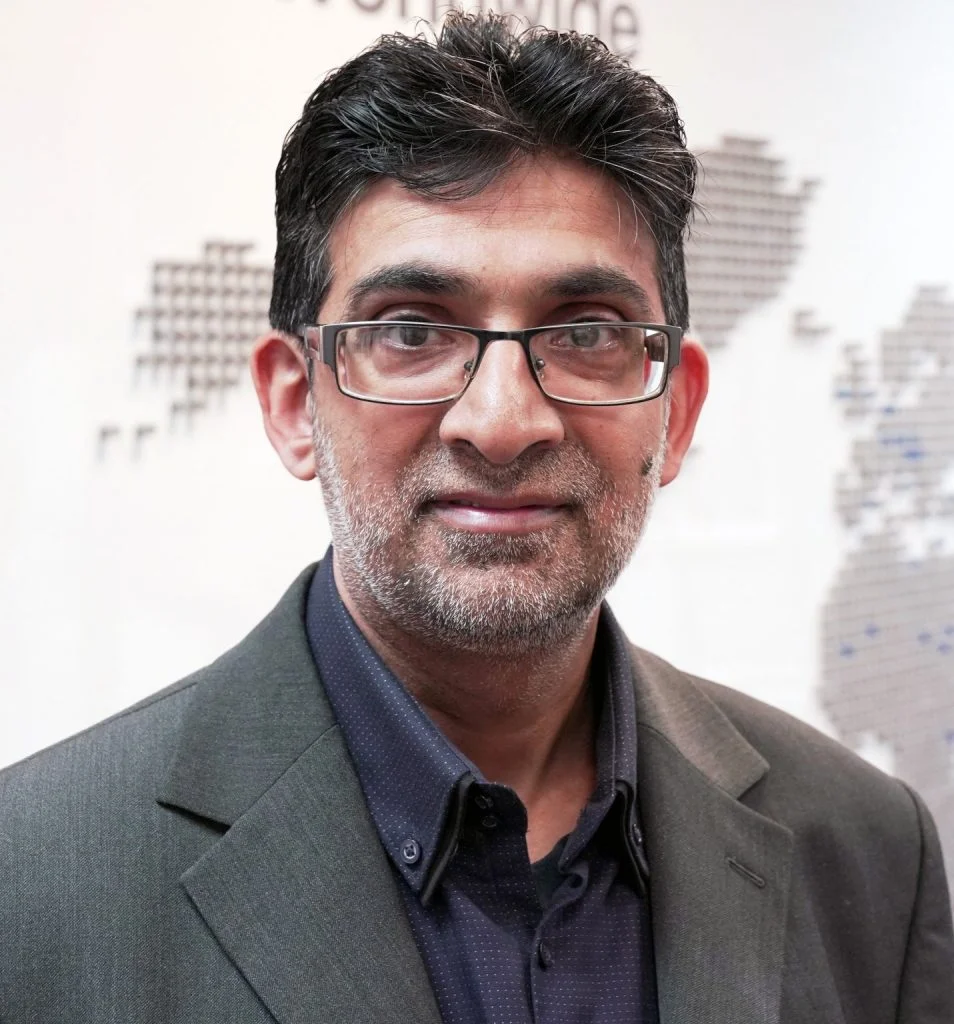
It was an opportunity for Programme Quality to share learning paper Creating Community Hope Action Teams (CHATs): A Snapshot of IRW’s Faith-Sensitive Approach to Protection and Inclusion which draws on experiences from Mali, Ethiopia, Malawi, and South Sudan. Bushra Rehman, Child Protection and Inclusion Advisor for Islamic Relief Worldwide, explains the importance of CHATs and the impact they can have on vulnerable communities.
It felt right to launch the paper in a space among people who understand the complexity of working at the intersection of gender, displacement, and religion, and who know that real change doesn’t come from ticking boxes, but from building trust.
Creating Community Hope Action Teams (CHATs) explores how CHATs – local volunteer groups rooted in faith and community structures – are trained to raise awareness and respond to issues like child protection, gender-based violence, and harmful practices.
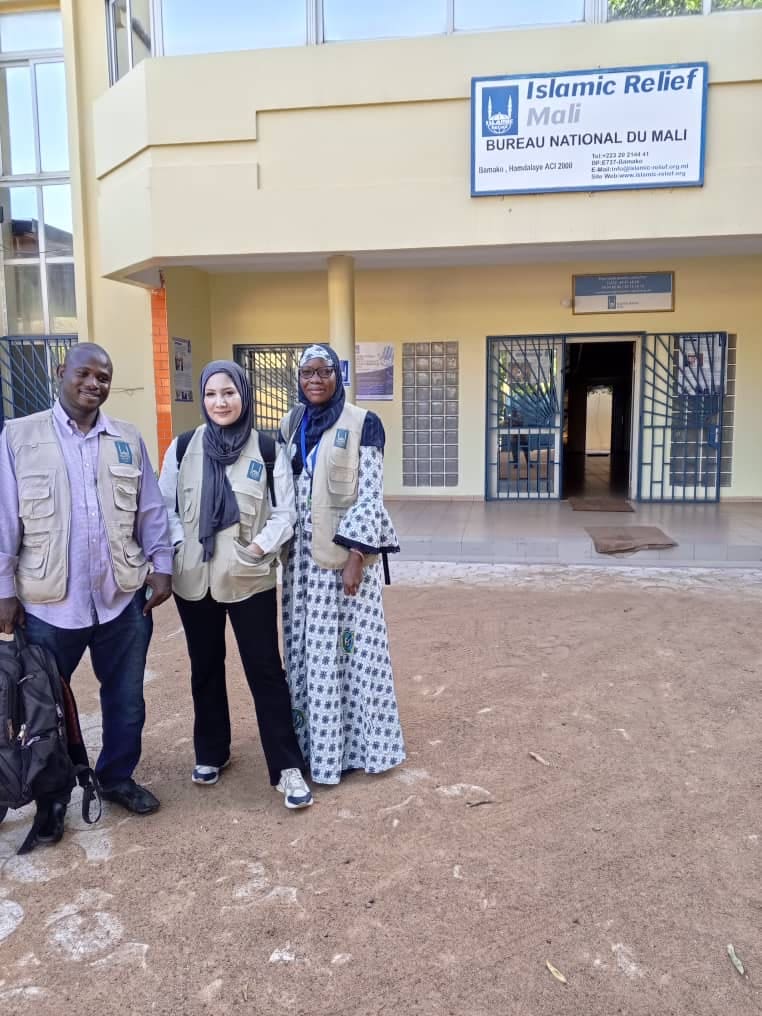
Writing the paper, in collaboration with our staff in South Sudan, Mali, Malawi and Ethiopia, was an illuminating experience. However, visiting Mali and sitting with the CHATs in person really brought the whole thing to life.
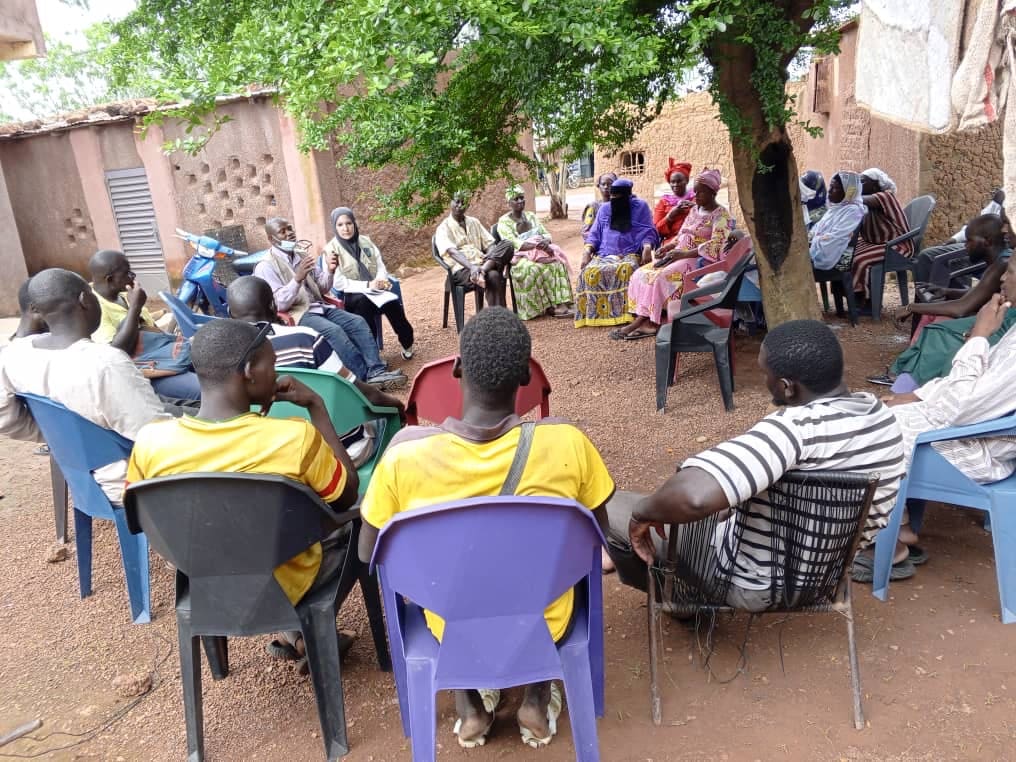
These weren’t theoretical committees. They were made up of imams, teachers, mothers, older and young individuals – ordinary people who had taken on the enormous task of changing how their communities talk about protection. Some of the CHATs had been meeting monthly for over a year, and despite limited resources, they were still going strong.
In 1 of the villages I visited, the CHAT members spoke openly about the lack of emotional support women receive during pregnancy and childbirth. They explained how men were often absent during these critical times, not out of malice, but because of social norms that told them it wasn’t their role. So, the CHAT organised awareness sessions; not big events, just simple conversations, where they used Islamic teachings to remind men of their duty to show compassion and care.
One imam told us, “the change we see is what motivates us, not financial gain.” That sentence captured the spirit of the work more than any indicator ever could.

Another CHAT member told me how, during the farming season when parents are away in the fields, young children are often left at home alone. It was seen as normal, even necessary. But through the CHAT, they began raising awareness about the risks children face when left unsupervised. They organised community discussions and eventually proposed a local solution: setting up shared community-based spaces where mothers could take turns looking after each other’s children.
It wasn’t a funded project. It was simply the community responding to a gap they recognised and doing something about it together.
The paper also looked at experiences from Malawi, Ethiopia, and South Sudan. In Ethiopia, for example, CHAT members have used traditional coffee ceremonies to create safe spaces for discussing difficult issues like FGM and early marriage. It’s a beautiful example of how CHATs are adapting to their own contexts: working with culture and with faith, not against them. I didn’t get to see that firsthand, but it confirmed what I felt in Mali: people already have the tools. They just need space and support to use them.
Read Creating Community Hope Action Teams (CHATs): A Snapshot of IRW’s Faith-Sensitive Approach to Protection and Inclusion to learn more about Islamic Relief’s work with CHATs.
BROWSE OTHER OPINIONS
FEATURED OPINIONS
- Saving our home: Time for urgent action on World Environment Day
- Gaza one year on: Endurance and exasperation
- Away from the headlines there is an opportunity for real climate action
- How the Core Humanitarian Standard guides and inspires my safeguarding work
- Leave in Hope: the end of the Bonn conference
MOST POPULAR TOPIC
View More